
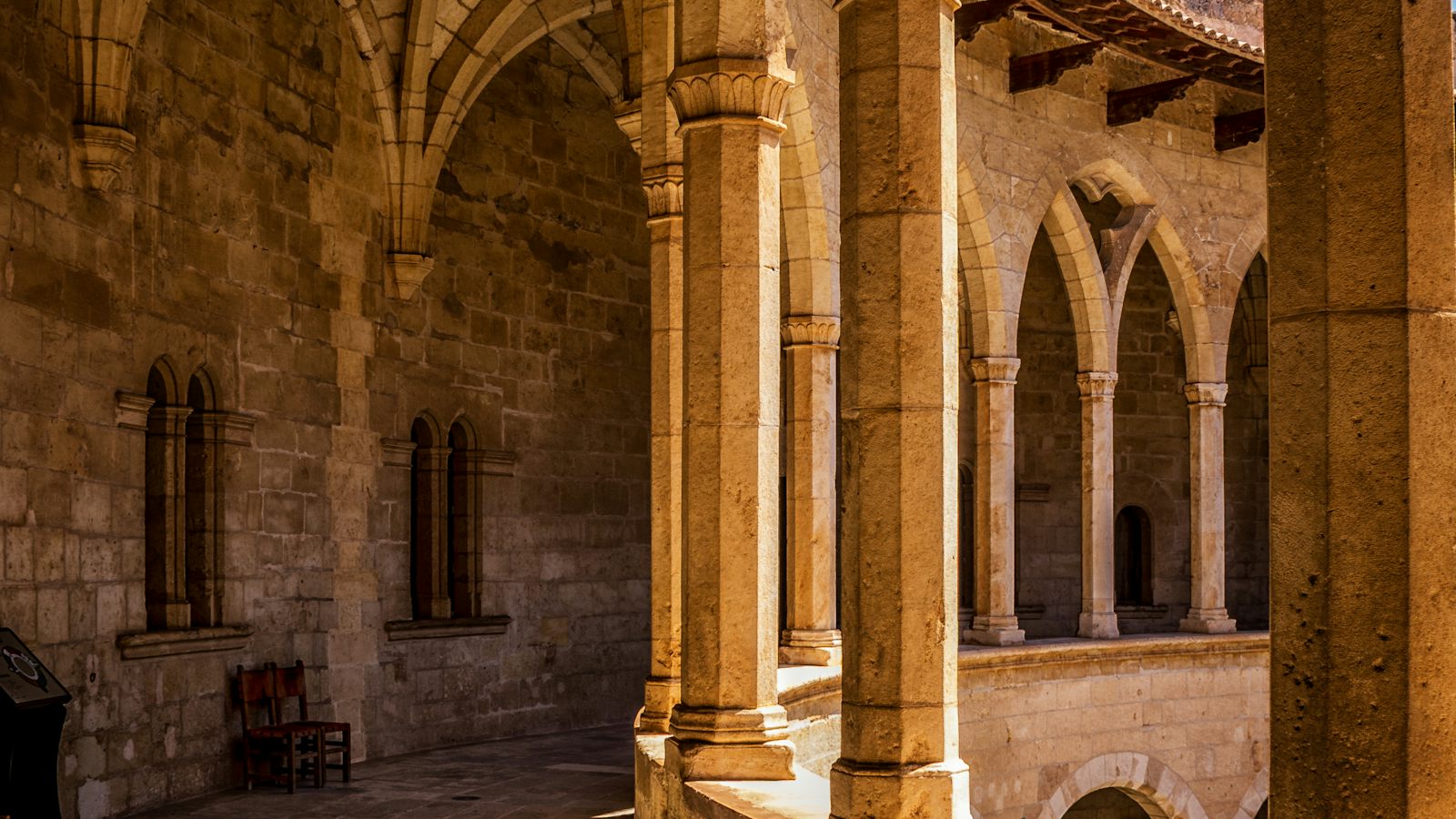
Why is La Verna important for pilgrims?
La Verna is the mountain where, according to tradition, Saint Francis received the stigmata, the wounds of Christ, in September 1224. It is, after Assisi, one of the major places of Franciscan pilgrimage.
Count Orlando of Chiusi gave the mountain to Francis in 1213 as a retreat especially favourable to contemplation. Francis had the Chapel of Santa Maria degli Angeli built around 1216-1218. In 1224 he went up the mountain for a forty-day fast before the feast of Saint Michael, and tradition holds that he received the stigmata around the middle of September.
A church was consecrated in 1260 with Saint Bonaventure present, and the Chapel of the Stigmata was built a few years later. Pope Benedict XV raised the church to a minor basilica in 1921.
What can you see and venerate at La Verna?
The sanctuary stands at about 1,128 metres on the southern slope of Monte Penna, which rises to 1,283 metres.
- The Chapel of the Stigmata: the chapel that marks the traditional site of the miracle.
- The Corridor of the Stigmata: a passage frescoed by Baccio Maria Bacci.
- The Basilica: dedicated to the Assumption, begun in 1348 and completed in 1509, with glazed terracottas by Andrea della Robbia and his workshop.
- The Chapel of Santa Maria degli Angeli: the early chapel from Francis's time.
- The Chapel of the Relics: it holds a habit said to have belonged to Saint Francis.
- The museum: opened in 2002, with choir books and liturgical objects.
The surrounding fir and beech forest is kept by the friars, and the Way of Saint Francis, a 110 km route from Rimini, ends at La Verna.
How do you get to La Verna?
La Verna stands on a wooded mountain above the village of Chiusi della Verna, in the Casentino valley of eastern Tuscany. It is a remote place, so plan the last stretch carefully.
- By train and bus: the nearest railway station is Bibbiena. From Florence, take a train to Arezzo and change for Bibbiena. From Bibbiena, AT Bus lines H12 and H11 run to Chiusi della Verna, and from the village you continue to the sanctuary on foot. Check the timetables before you travel.
- By car from the north: leave the A14 at Cesena Nord, follow the SS3bis/E45 to Pieve Santo Stefano Nord, then the SP208 to Chiusi della Verna. Alternatively, leave the A1 at Firenze Sud and follow the SS67 to Pontassieve, then the SS70 through Consuma, Poppi and Bibbiena.
- By car from the south: leave the A1 at Arezzo and follow the SS71 to Bibbiena, then the signs for Chiusi della Verna. You can also leave the A1 at Orte and follow the signs for Cesena (SS204, SS675, then the E45) to Pieve Santo Stefano Sud and the SP208.
When is La Verna open and when are Masses held?
Entry to the sanctuary is free.
Hours, at the time of writing — check the official website before visiting: the sanctuary is open from 6:30 to 21:30 from May to September and from 6:30 to 19:00 from October to April. The Chapel of the Stigmata is open from 7:30 to 18:30 from May to September and from 7:30 to 17:30 from October to April.
Masses are at 8:00, 11:00 and 16:00 on weekdays. On Sundays and holidays they are at 8:00, 10:00, 12:15 and 16:00 all year, with an extra Mass at 11:00 from June to September and another at 17:00 from May to September. The Hour of None and a procession are listed at 15:00.
La Verna is at altitude and the weather can be cool even in summer, so bring a warm layer. The procession and the Chapel of the Stigmata are the heart of a visit, so allow time for both.
Practical tips for pilgrims
- The sanctuary is at altitude, so bring warm clothes even in summer.
- Dress modestly and keep silence in the chapels.
- Allow at least a day to include the forest paths and the Mass.
- Use the bus from Bibbiena if you travel without a car; connections are limited.
- If you are walking the Way of Saint Francis, plan to arrive with time for prayer.